Blog
Strengthening Europe’s Coastlines with Nature: New Insights on Nature Based Solutions for Coastal Resilience
April 27, 2026
Coastal communities across Europe and beyond are facing growing risks from sea‑level rise, extreme weather events, and ecosystem degradation. Traditional approaches to coastal defence alone are increasingly proving insufficient - technically, financially, and environmentally. Against this backdrop, Nature‑based Solutions (NbS) are emerging not as niche alternatives, but as viable components of resilient coastal infrastructure systems.
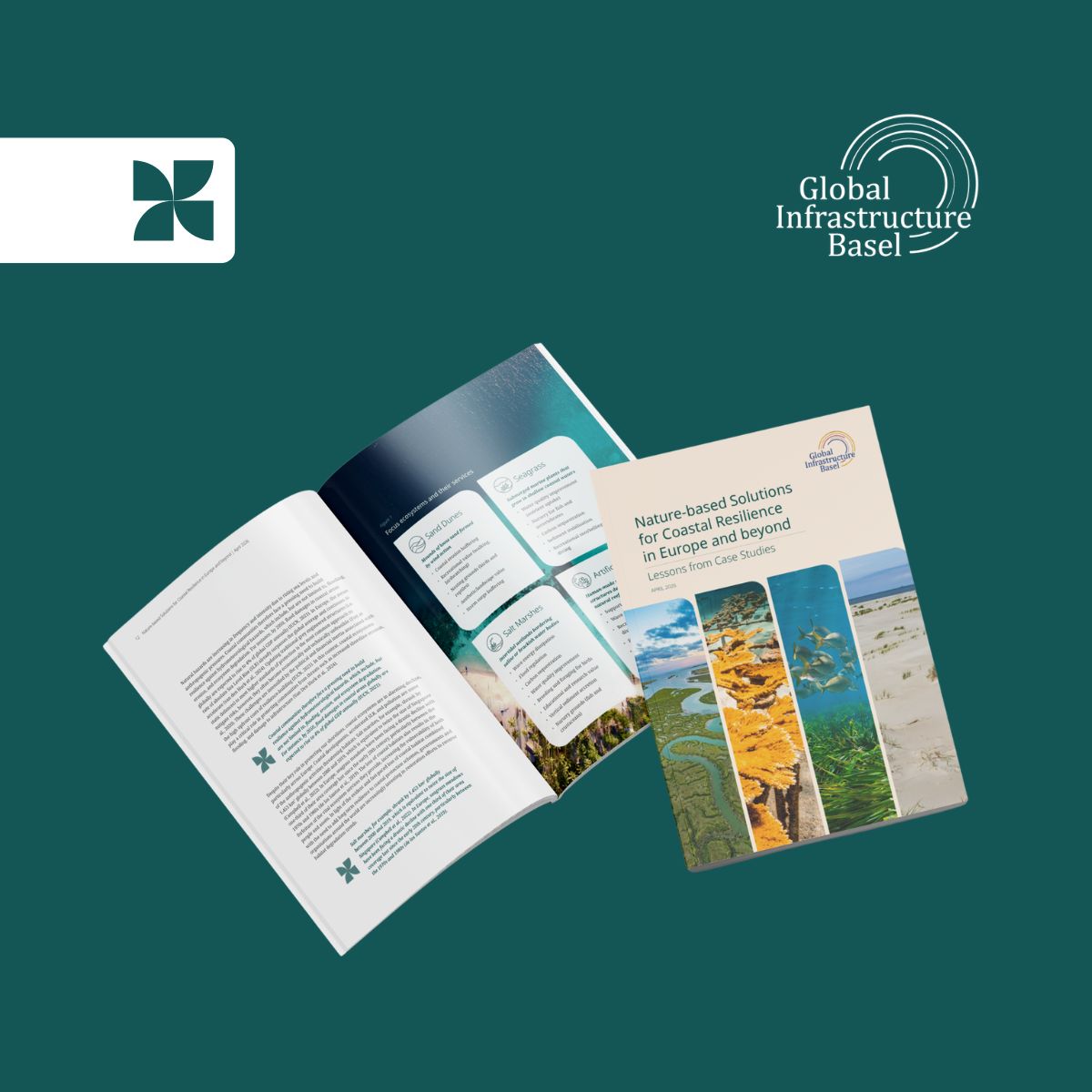
Global Infrastructure Basel Foundation (GIB) new report, Nature‑Based Solutions for Coastal Resilience in Europe and Beyond: Lessons from Case Studies, offering one of the most comprehensive overviews to date of how nature can be integrated into coastal protection strategies - at scale and grounded in real‑world evidence.
Drawing on projects across Europe and beyond, the report examines how ecosystems such as sand dunes, salt marshes, seagrass meadows and artificial reefs are being used to reduce flood and erosion risks, while delivering wider environmental and socio‑economic benefits.
Crucially, the report moves beyond the question of whether NbS work, and focuses on how they can be implemented credibly and repeatedly. It takes a pragmatic, evidence‑based approach, analysing:
The findings are directed at policy‑makers, infrastructure authorities, coastal managers and financiers seeking to move beyond experimentation and embed NbS within mainstream coastal adaptation strategies.
Across the case studies, several recurring enablers stand out:
For financial institutions, these findings underline that NbS become financeable when they are embedded in credible policy frameworks, supported by predictable funding and governed with clear lines of accountability - rather than treated as isolated pilots.
One of the report’s key messages is that the challenge is less about technical feasibility, and more about institutional and financial design.
Successful cases consistently show that NbS scale when:
These conditions align closely with the requirements of policy‑driven lending, framework loans and blended finance instruments, and help explain why NbS are increasingly relevant for institutions focused on climate adaptation and resilience financing.
“This report shows that Nature‑based Solutions are no longer experimental - they are viable components of resilient coastal infrastructure systems,” says Juraj Jurík, Director of Infrastructure & Nature at GIB.
“Scaling them, however, requires a shift in mindset: from isolated projects to integrated planning, from short‑term budgets to long‑term finance, and from ‘grey versus green’ debates to hybrid solutions that work with natural processes rather than against them.”
This perspective lies at the heart of GIB’s Infrastructure & Nature work: supporting approaches that are technically robust, financially credible and capable of delivering measurable impact at scale.
With coastal risks intensifying and public budgets under increasing pressure, decision‑makers and financial institutions alike are seeking solutions that are adaptive, cost‑effective and future‑proof. Nature‑based Solutions offer significant potential - but only when supported by evidence, sound governance and financing structures that recognise their role as infrastructure.
By consolidating lessons from a wide range of geographies and project types, this report provides a clear reference point for institutions aiming to translate ambition on NbS into investable, implementable coastal resilience strategies.